
How to Understand and Improve Your Credit Score in Australia
Your credit file influences the rates lenders offer and the products you can access. Here is how the Australian credit reporting system works and what people commonly do to manage their profile.
In Australia, access to borrowing and the rate at which lenders price that borrowing are influenced significantly by what your credit file shows. Under Comprehensive Credit Reporting (CCR), introduced progressively from 2018, lenders can see not just negative credit events but also consistent repayment behaviour over time.
Understanding how the system works, what the three Australian credit bureaux hold about you, and what factors influence your score is useful background for anyone thinking about borrowing, whether now or in the future.
How Comprehensive Credit Reporting Works
Before CCR, Australian credit files primarily recorded negative events: defaults, court judgments, and missed payments. Under CCR, participating lenders also report positive information, including whether repayments are being made on time each month.
This means lenders considering an application can now see a fuller picture of someone’s credit behaviour, not just whether they have had problems in the past. The Office of the Australian Information Commissioner publishes detailed guidance on how credit reporting works under the Privacy Act, including what information can be held, how long it stays on file, and what rights individuals have.
Each of the three Australian credit bureaux holds its own file. Lenders choose which bureau or bureaux to access when assessing an application, which is why scores can differ across bureaux and why checking more than one is useful.
How to Check Your Credit File
All three Australian credit bureaux are required by law to provide individuals with a free copy of their credit report once every three months. Checking your own credit report does not affect your credit score as it is treated as a soft enquiry rather than a hard enquiry from a lender.
Common things people check include whether all listed accounts are ones they recognise, whether any defaults or late payments are recorded accurately, and whether any credit enquiries they don’t recall having made appear on the file. The OAIC’s guide to accessing and correcting your credit report explains the process for disputing errors.
Errors on a credit file can be disputed directly with the credit provider first, then with the bureau if needed. Under the Privacy Act, errors must be investigated and corrected free of charge. The OAIC’s correction process guide covers this in detail. No third-party credit repair company can do anything in this process that individuals cannot do themselves at no cost.
Credit Score Ranges and What They Generally Indicate
Score ranges differ between bureaux and individual lenders have their own assessment policies, so no single range applies universally. The table below reflects how scores are broadly described in publicly available guidance, not any specific lender’s policy.
| Score Range | General Description | What Lenders Commonly Note |
|---|---|---|
| Below ~650 | Below average | May face higher rate pricing or limited product access |
| 650–699 | Average | Standard products generally accessible; rates may vary |
| 700–799 | Good | Standard prime rates typically available |
| 800+ | Excellent | Strongest pricing and broadest policy flexibility |
Each bureau publishes its own score methodology. Equifax, Experian, and illion each provide explanatory guides on what factors influence scores within their systems.
What Influences a Credit Score
The factors below are commonly cited by credit bureaux and lenders as influential in credit assessments. Their relative weight varies by lender and bureau.
Repayment history
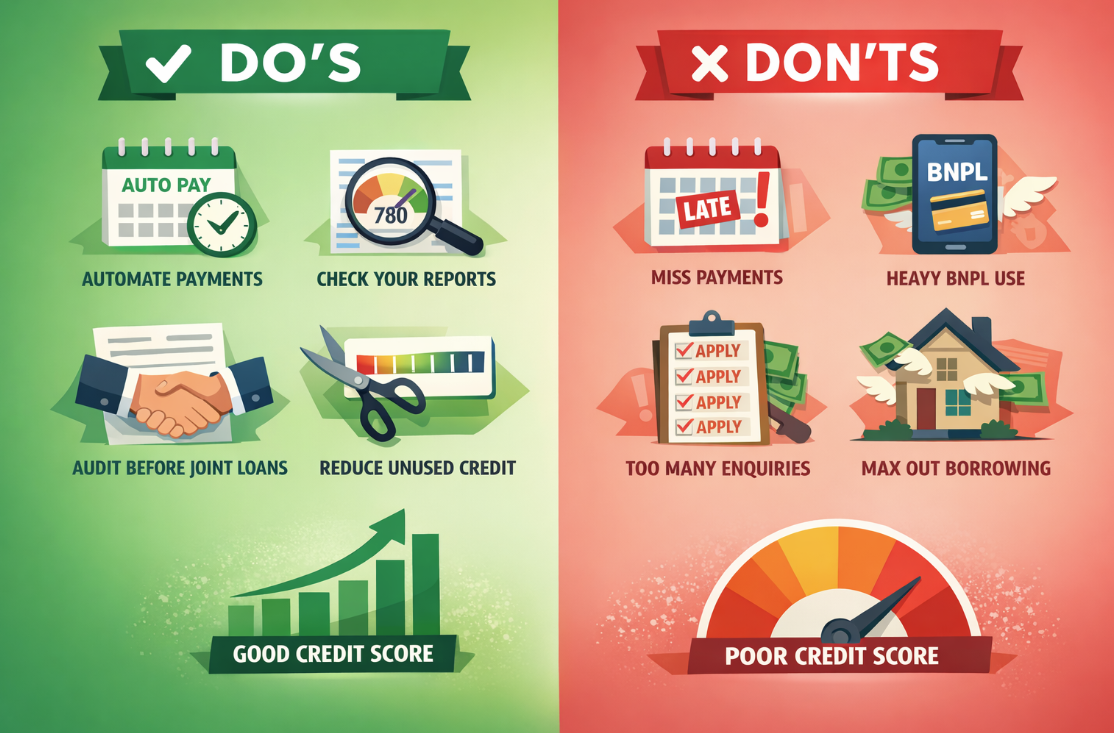
Under CCR, lenders place significant weight on the consistency of repayments over the most recent 24 months. A pattern of on-time repayments across all accounts is generally considered the most influential positive factor. Conversely, a single late payment (30+ days) recorded in this window can affect assessments significantly. Many people find automating minimum repayments on all accounts removes the risk of an accidental missed payment.
Defaults and negative listings
Defaults are recorded when a debt of $150 or more is overdue by 60 days or more. They remain on a credit file for five years. Old utility or telecommunications debts are a common source of defaults people are unaware of, since a missed $20 phone bill can generate a listing in the same way a missed loan payment can. Reviewing the file for these is commonly the first step people take.
The OAIC’s guidance on defaults and credit reporting explains the rules around how defaults are listed and removed.
Credit enquiries
Each time a lender conducts a hard enquiry on a credit file as part of an application assessment, it is recorded and remains visible for five years. Multiple enquiries within a short period can be interpreted by subsequent lenders as a sign of frequent credit-seeking. Mortgage brokers can often run pre-assessments without triggering hard enquiries, and can batch applications where multiple lenders need to be approached.
Total available credit and utilisation
Australian lenders assess total available credit limits, not just balances in use. A high combined limit across credit cards and Buy Now Pay Later accounts can reduce assessed borrowing capacity even if the balances are zero, because lenders apply a notional repayment to those limits. Many lenders also assess serviceability as if those limits are fully drawn.
Credit utilisation (the percentage of available credit currently used) is also a factor in score calculations. Keeping balances well below total limits is generally associated with better score outcomes, though the specific threshold varies by bureau.
Buy Now Pay Later accounts
BNPL accounts are increasingly factored into credit assessments by Australian lenders. Frequent BNPL usage can be interpreted as a signal of cash flow reliance, and open BNPL limits can reduce assessed borrowing capacity in the same way credit card limits do. The reporting treatment of BNPL varies by provider and lender, and this area of credit reporting continues to evolve.
The ASIC MoneySmart guide to Buy Now Pay Later covers how these products work and their financial implications.
Joint applications and financial associations
In Australia, a joint loan application creates a financial association between the two applicants. This means one applicant’s credit history becomes visible in the context of applications involving the other. Associations persist on file unless formally removed after the shared account is closed. Reviewing both files before making a joint application is a step commonly cited by mortgage brokers as good preparation.
What people commonly do to manage their credit profile
The following steps are commonly described by lenders, brokers, and credit bureaux as useful starting points. What is relevant will depend on individual circumstances.
-
1
Request a free credit report from all three bureaux Free today
A common starting point is requesting reports from Equifax, Experian, and illion directly. Reports are available free every three months from each bureau. Scores differ between bureaux and lenders choose which to reference, so seeing all three gives the fullest picture. -
2
Check for errors or unfamiliar listings Free today
Reviewing each report for accounts or enquiries that are not recognised, or for defaults that may have been listed incorrectly, is a standard first pass. The OAIC correction process explains how to dispute anything that appears inaccurate. -
3
Review total credit limits relative to upcoming borrowing goals
People who are preparing to apply for a mortgage commonly review their total credit card and BNPL limits, as these can affect assessed borrowing capacity independently of the score itself. A licensed mortgage broker can advise on what is relevant for a specific application. -
4
Set up automated repayments on all accounts
Many people find that automating minimum repayments on all accounts removes the risk of an accidental late payment appearing on the file. Lenders and brokers commonly note that consistency of repayment over the 24 months prior to an application is one of the most visible positive signals on a credit file. -
5
Speak with a licensed mortgage broker before applying
A licensed mortgage broker can review a credit file in the context of a specific borrowing goal, identify what is likely to affect an assessment, and advise on sequencing. The ASIC MoneySmart guide to mortgage brokers explains what brokers do and how they are remunerated.
No third-party credit repair company can access or correct a credit file in ways that individuals cannot do themselves for free. The OAIC and ASIC MoneySmart both note this clearly. The ASIC MoneySmart page on credit repair explains what these services can and cannot do.
Understanding how your credit file works is straightforward. The part most people find harder is acting on it consistently over time. If you want to build that kind of financial habit alongside others working through the same journey, MSH is a free community built around exactly that.
Join free here →