
The 2026 Budget Just Changed the Rules for Investors
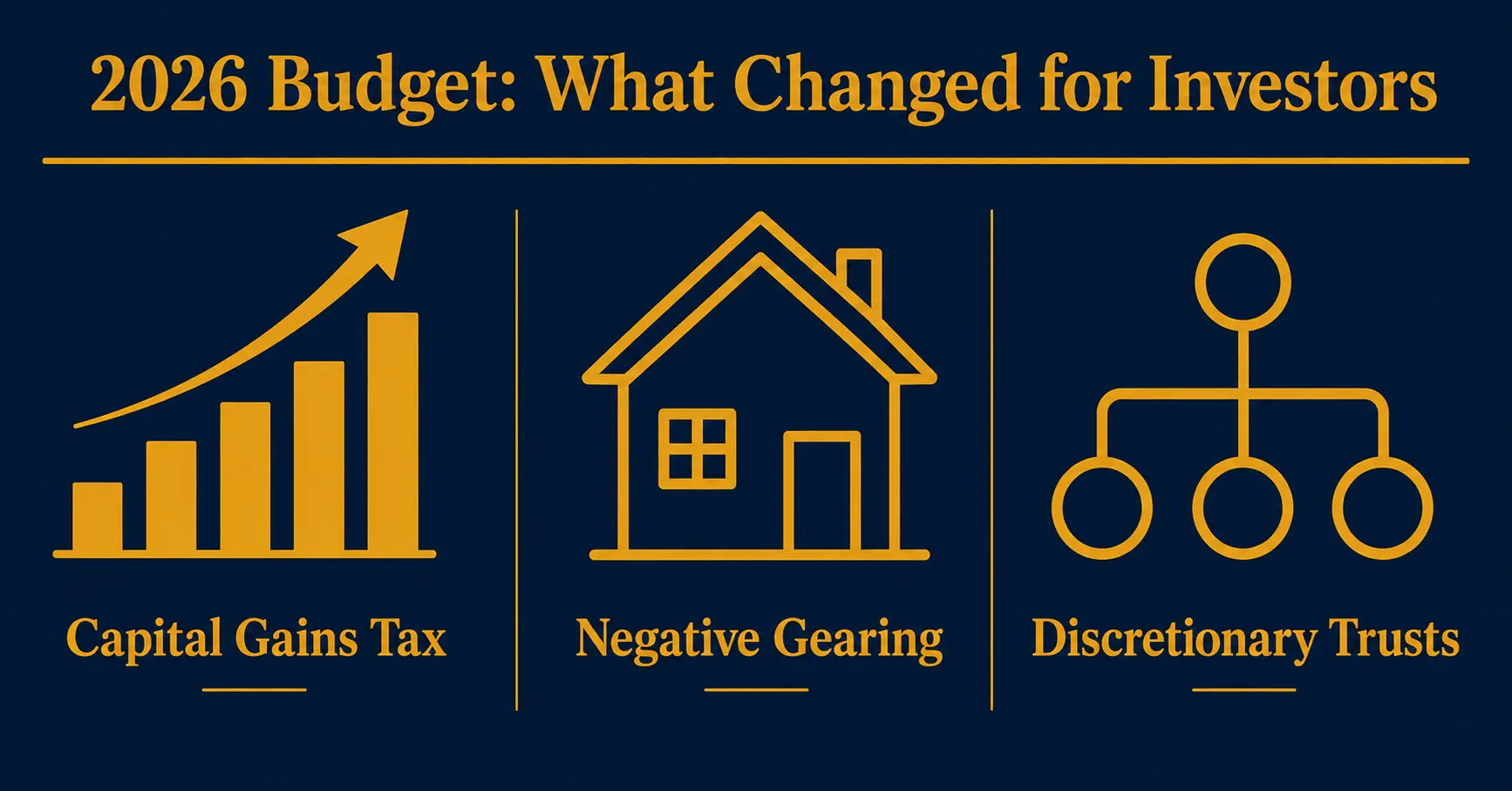
The 2026-27 federal budget rewrote three of the most important rules in Australian investing. Here is what changed, what it means, and what people are thinking about next.
For over two decades, Australian investors have made decisions based on a stable set of rules: a 50% capital gains tax discount for assets held more than 12 months, the ability to offset property losses against wage income, and the flexibility of distributing earnings through family trusts. The 2026-27 federal budget changed all three.
Treasurer Jim Chalmers handed down the budget on 12 May 2026, describing it as the most ambitious tax reform in 26 years. For investors, it is the most significant shift in the framework since the Howard government introduced the 50% CGT discount in 1999. The changes are prospective, not retrospective. But the rules that apply to new decisions made from Budget night onward are different from the ones that applied before it.
This article covers what changed, the grandfathering arrangements that protect existing investors, and the common questions people are working through right now.
Why You Should Care
These are not minor adjustments to the edges of the tax system. The capital gains tax discount has shaped how Australians think about long-term investing, property, and retirement planning for a generation. Negative gearing has been central to residential property investment strategies for decades. Discretionary trusts are used by roughly one million Australians to hold investments and run businesses. Understanding what changed, and critically, what is grandfathered, is the foundation for any informed conversation with a registered tax agent.
What Actually Changed
From 1 July 2027, the 50% CGT discount for individuals, trusts, and partnerships will be replaced with cost base indexation and a new 30% minimum tax rate on capital gains. Under the new system, the taxable gain is calculated after adjusting the original cost base for inflation, meaning only real gains above the inflation rate are taxed. A flat 30% rate then applies to those real gains.
The practical effect is that investors with modest gains close to the inflation rate will pay less tax than under the old system. Those with gains significantly above inflation will pay more. The government has framed this as restoring the taxation of “real” gains rather than gains inflated by general price rises.
Grandfathering arrangements are significant. The 50% CGT discount will continue to apply to all gains arising before 1 July 2027. Gains accrued on existing investments prior to that date retain the old rules. Investors who acquire new residential properties can choose between the 50% discount or the new arrangements when they eventually sell. The CGT discount inside superannuation funds is not affected at all. Existing small business CGT concessions are also unchanged.
The ATO’s CGT guidance is the most reliable reference for understanding how gains are currently calculated before comparing that framework to the new rules.
Negative gearing, the practice of deducting investment property losses against other income such as wages, will be limited to new residential builds from 1 July 2027. The deduction against wage income that has long been a feature of established property investment will not apply to properties purchased after Budget night, 12 May 2026.
Properties owned as at 7:30pm AEST on 12 May 2026 are fully protected. All existing negatively geared properties continue under current arrangements indefinitely, until those properties are sold. This is a firm grandfathering commitment.
For investors who purchase established residential property after Budget night: deductions against other income like wages will no longer be available. Losses can still be deducted against residential property income such as rent or future capital gains, and unused losses can be carried forward to future years. Investments that support government affordable housing programs are also exempt from the restrictions.
ASIC’s MoneySmart has a clear property investment explainer covering the mechanics of rental deductions as they currently stand.
From 1 July 2028, a minimum 30% tax rate will apply to discretionary trusts, paid by the trustee. Discretionary trusts have historically allowed income to be distributed to beneficiaries at their individual marginal tax rates, which in many cases meant family members on lower incomes received distributions taxed at a lower rate. The new floor rate brings the tax outcome closer to what a wage earner on a comparable income would pay.
Beneficiaries will continue to declare trust income in their own tax returns and pay tax at their marginal rates. Non-corporate beneficiaries receive non-refundable credits for tax already paid by the trustee, avoiding double taxation while ensuring the 30% floor is met. The change does not affect fixed trusts, special disability trusts, or charitable trusts.
Around 40% of active small businesses currently operating under discretionary trusts are not expected to pay any additional tax or need to restructure. For those who do need to restructure, a three-year rollover relief window opens from 1 July 2027, providing relief from income tax and CGT consequences when moving into a company, fixed trust, or other entity structure. This window runs until 30 June 2030.
The ATO’s trust guidance covers the existing framework. Anyone operating through a discretionary trust should plan to consult a registered tax agent well before the 2027 rollover window opens.
The Bigger Picture: Change Is the Only Constant
It is worth stepping back for a moment. The 2026 budget changes feel significant because they are. But they are also part of a pattern that stretches back decades, and they will not be the last.
For someone starting their investing journey today with a 40 to 50 year working life ahead, the 2026 budget will not be the only time the rules change. The 50% CGT discount itself was introduced in 1999, replacing a full indexation system. Superannuation contribution caps have been adjusted multiple times. Negative gearing was briefly abolished in 1985 before being reinstated 18 months later. Trust taxation debates have surfaced in multiple election campaigns over three decades. Every generation of investors navigates a shifting legislative landscape.
The more useful question is not “what if the rules change again?” but rather “what stays true regardless of the rules?” The compounding of returns over time, the power of consistent contributions, and the discipline to stay invested through uncertainty are not products of any particular tax arrangement. They are structural advantages that belong to anyone who chooses to participate.
Whatever changes come, history consistently shows that those who invested, even imperfectly, even under less favourable tax rules, ended up materially better off than those who waited for certainty before starting. Tax policy shapes the efficiency of returns. It does not determine whether participation beats non-participation.
Common First Steps People Are Taking
-
1Mapping existing assets and recording acquisition dates. A common first step is confirming which assets are grandfathered under current CGT rules. Assets held before 1 July 2027 retain the 50% discount on gains accrued to that date. Understanding what is protected and what is not is the starting point for any further planning, and it costs nothing to do.
-
2Reviewing the timeline for existing investment properties. Many investors are considering whether properties purchased before Budget night will be held long-term, given that the CGT rules applying on eventual sale will depend partly on when gains accrued. This kind of timeline review is a desk exercise that can be done before engaging a professional.
-
3Comparing the economics of new builds versus established properties. For those who have been considering a property investment, the landscape has changed materially. New builds retain access to both the 50% CGT discount option and full negative gearing deductibility. Established properties purchased after Budget night do not. Many investors are now running the numbers on each scenario using ASIC’s MoneySmart property investment tools.
-
4Noting the 2027 rollover relief window for trust holders. Investors holding assets through discretionary trusts are identifying the 2027 to 2030 rollover window as the relevant planning horizon. The assessment of whether restructuring is worthwhile is not straightforward and requires professional input, but the time to begin that conversation is before the window opens, not after.
-
5Bookmarking the official sources. Many investors find it useful to follow the official budget tax reform page directly, rather than relying on secondhand commentary. Legislation will be drafted in the months ahead and the ATO will issue guidance on implementation. Changes to announced policy, while uncommon, do happen. Primary sources are always more reliable than interpretations of them.
The Habit That Outlasts Any Policy
The investors who navigate budget changes most effectively tend to be the ones who understand the broad architecture of what changed, ask their advisers specific questions rather than general ones, and resist reacting before the legislation is settled. Premature restructuring can be as costly as inaction.
More broadly, a 40 to 50 year investing journey will cross many budgets, many governments, and many rule changes yet to be written. The discipline of staying informed, staying invested, and adjusting thoughtfully when required is a habit worth building now, not when the next change arrives.
If you want to build these habits alongside others working through the same journey, MSH is a free community built around exactly that. Join free here.
- Official budget tax reform overview — Budget 2026-27, Australian Government
budget.gov.au/content/04-tax-reform.htm - Prime Minister’s announcement on tax reform — PM.gov.au
pm.gov.au/media/tax-reform-workers-businesses-and-future-generations - CGT and negative gearing changes explained — SuperGuide
superguide.com.au/super-booster/federal-budget-2026-overview - Discretionary trust minimum tax — Budget 2026 — SmartCompany
smartcompany.com.au/federal-budget-2026/budget-2026-trusts/ - Five-minute budget guide — SBS News
sbs.com.au/news/article/federal-budget-2026-five-minute-guide/2g0jf7tvz - ATO capital gains tax guidance
ato.gov.au — Capital Gains Tax - ATO trusts guidance
ato.gov.au — Trusts - ASIC MoneySmart — property investment
moneysmart.gov.au/property-investment - Trust minimum tax detail — AusTax.tools
austax.tools/tax-insights/federal-budget-2026-trust-minimum-tax/ - Australian Parliament House — track legislation progress
aph.gov.au
Build the Habits. Stay the Course.
MSH is a free education and accountability community built around the four pillars of Wealth, Career, Network, and Health. Join thousands of members who are turning knowledge into action.
Join MSH Free Today