
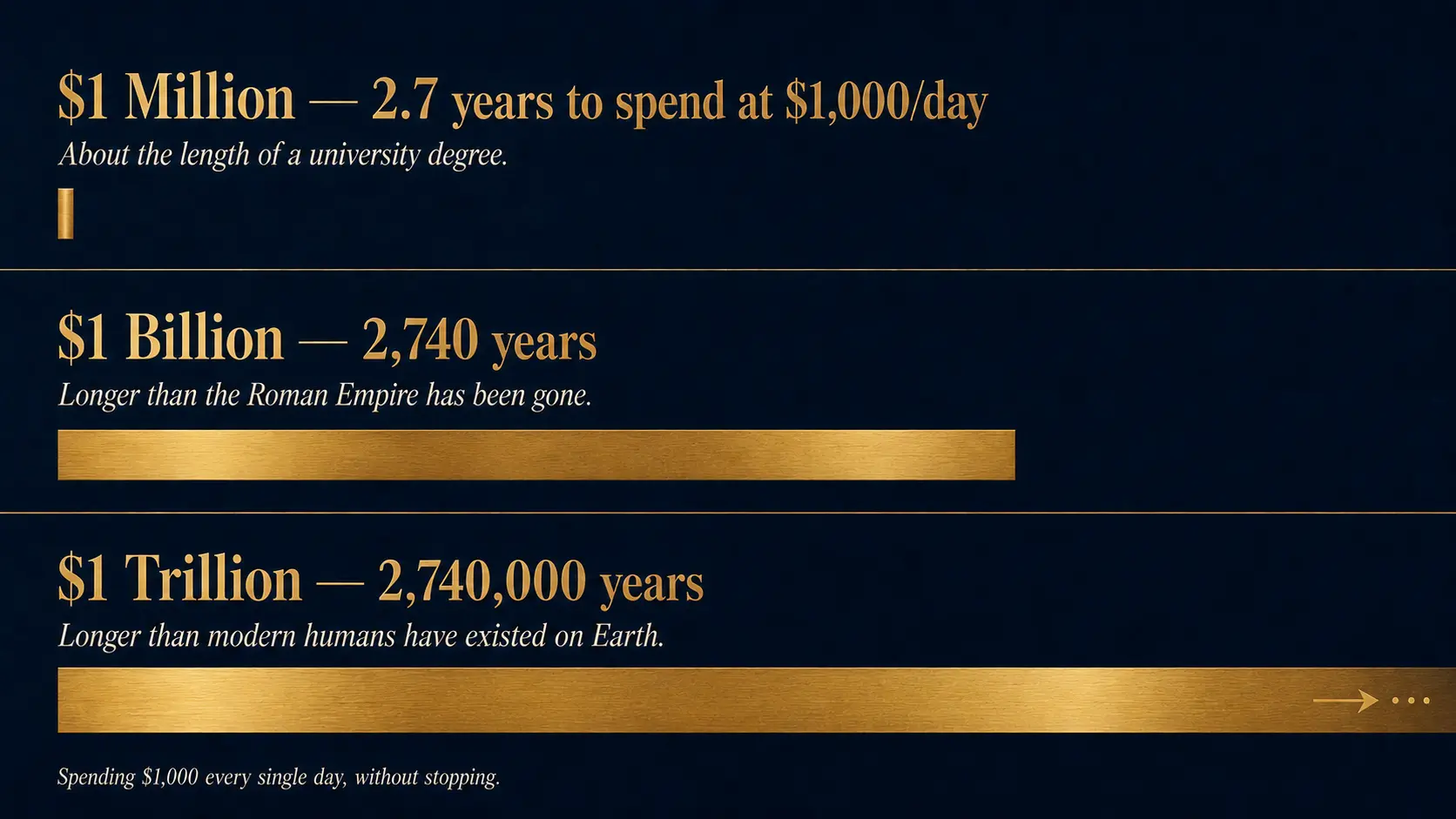
One Trillion Dollars: A Number So Big It Breaks Your Brain
Your brain is not equipped to understand a trillion dollars. Neither is anyone else’s. That’s not a personal failing. It’s a quirk of human cognition that has real implications for how we think about wealth, inequality, and our own financial goals.
On 12 June 2026, Elon Musk became the first person in recorded history to cross the one trillion dollar net worth threshold, pushed there by the SpaceX IPO. The number was everywhere immediately. Headlines repeated it. Social media recycled it. And then, almost universally, people moved on without really processing what they had just read.
This article is an attempt to make that number real. Not through political commentary, not through argument, but through comparison. Because the gap between a million, a billion, and a trillion is so vast that treating them as points on the same scale is like treating a puddle, a swimming pool, and the Pacific Ocean as similar-sized bodies of water.
Select an amount, then choose a lens to make it real.
Why Your Brain Can’t Handle This
Psychologists and cognitive scientists refer to a phenomenon called scope insensitivity: the human tendency to respond emotionally to numbers in ways that don’t scale with the actual size of the number. Research by psychologist Paul Slovic and colleagues found that people’s emotional response to 2,000 birds dying in an oil spill was nearly identical to their response to 200,000 birds dying. The numbers are orders of magnitude different. The emotional reaction barely shifts.
The same effect applies to wealth. A million dollars triggers one level of reaction. A billion triggers a slightly stronger one. A trillion triggers roughly the same emotional response as a billion, despite being a thousand times larger. The brain simply has no reference point.
This is not a trivial observation. It shapes everything from public policy debates about government spending, to how individuals think about retirement targets, to how financial media covers wealth.
The Three Numbers You Probably Confuse
Here is a comparison that many people find useful for grounding the difference between these three scales. If you counted to one million at a rate of one number per second, without stopping, it would take approximately 11 and a half days. To count to one billion at the same rate would take 31.7 years. To count to one trillion would take 31,688 years, or roughly the same span of time as separates us from the last Ice Age.
Put differently: a million seconds ago was about two weeks ago. A billion seconds ago was 1994. A trillion seconds ago, modern humans had not yet arrived in Europe.
Or consider it in spending terms. If someone had begun spending one million dollars every single day from the birth of Christ, they would have spent approximately $730 billion by now. They would still need another 737 years of spending a million dollars a day to reach a trillion.
What It Means for How We Think About Wealth Goals
None of this is an argument about whether one person should or should not be worth a trillion dollars. That is a political and philosophical question with thoughtful people on every side of it. The point here is more practical: understanding the scale of large numbers changes how you set your own goals.
For most people, the meaningful wealth milestones are not billions. They are the kind of numbers that change day-to-day life: an emergency fund that eliminates financial anxiety, a debt-free position that frees up monthly cash flow, an investment balance that can generate passive income, a retirement figure that provides genuine security. These goals are achievable. They are also, at the scale of a trillion, genuinely invisible on the chart.
That invisibility is worth sitting with. When media coverage normalises discussions of billion and trillion-dollar fortunes, it can make ordinary financial milestones feel trivial or even embarrassing by comparison. Financial educators and researchers in the field of money psychology note that one of the most common barriers to people starting their wealth-building journey is a sense that the amounts they can contribute are “not worth it” compared to what they read about.
They are worth it. Compound growth does not care about the scale at which it starts. It cares about time and consistency. ASIC’s MoneySmart compound interest calculator will show you the same mathematics Musk’s equity stakes benefited from, operating at whatever scale you actually have access to.
The Psychological Reframe
A useful reframe that many wealth educators offer is this: instead of measuring your financial progress against the largest number you have ever read about, measure it against your own prior position. The relevant question is not “how far am I from a trillion?” It is “how far am I from where I was twelve months ago, and is the direction right?”
Musk himself did not start by thinking about trillions. He started by reinvesting $180 million from a PayPal payout into two companies most people thought would fail. The trillion came from twenty-four years of that position being held, growing, crashing, recovering, and ultimately being valued by public markets at a number that had never appeared next to a person’s name before.
The lesson is not that everyone should start a rocket company. It is that the size of the starting amount matters far less than the habit of participating, the patience to stay invested, and the willingness to let time do its work.
One trillion dollars is a number that exists outside normal human experience. Understanding just how far outside it sits is not an exercise in envy or despair. It is a reminder that the financial goals within reach of most people, while humble by comparison, are built by exactly the same forces. Just at a scale the brain can actually comprehend.
If you want to think about your own wealth-building journey alongside others working through the same questions, MSH is a free community built around exactly that.
Join free here