
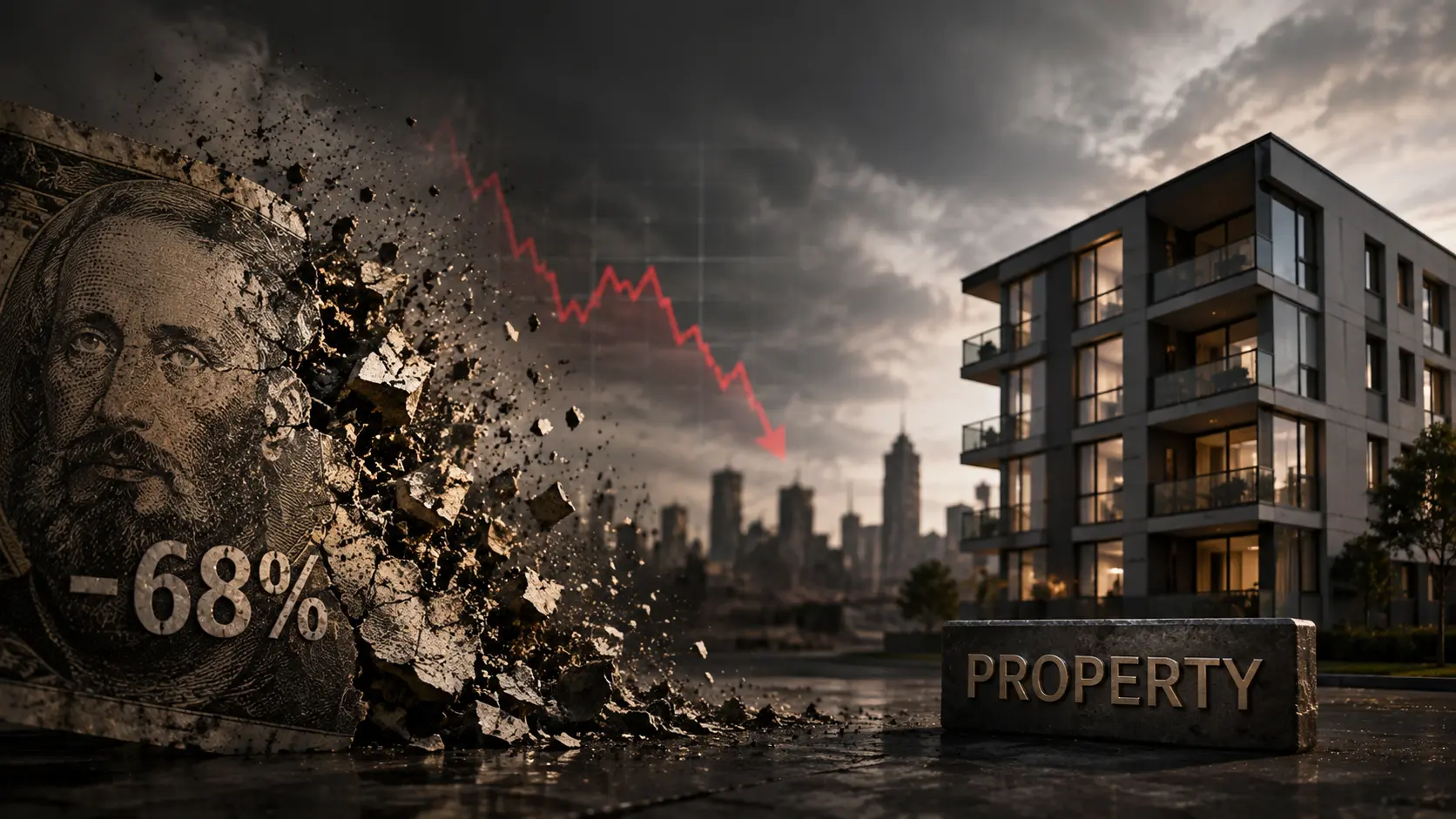
Property Is Supposed to Survive a Currency Collapse. In One Country It Lost 68% of Its Value Anyway
From Knowledge to Action: what actually happened to house prices in four of the world’s most extreme inflation episodes.
Between September 2016 and 2018, in the middle of one of the worst hyperinflations ever recorded, the average Caracas apartment didn’t hold its value against the collapsing bolívar. It lost around 68% of its value, measured in US dollars, in two years. “Property always protects you when a currency collapses” is one of the most repeated lines in finance conversation. In Venezuela, for a while, it didn’t.
This article reports on what actually happened to property prices, mortgages and transaction activity in four countries that lived through extreme or chronic inflation: Zimbabwe, Venezuela, Turkey and Argentina. Each episode is different in scale and cause, and each produced a different result for property.
By the end, you’ll have four real, documented cases to weigh against the general assumption, rather than one line repeated without evidence behind it.
Why You Should Care
“Property protects you from inflation” gets stated as an established rule in everyday finance conversation, but it’s rarely tested against the most extreme real-world cases. These four countries are among the clearest tests available: currencies that lost most or all of their value, in some cases within months. What happened to property in each of them is a matter of record, not opinion.
One note on the numbers before the country reports below: some of these episodes broke the systems that normally track prices. Zimbabwe’s government stopped publishing official inflation figures in mid-2008 as the crisis peaked, so later figures are academic reconstructions rather than official statistics. Data quality varies by country throughout this article for that reason.
Four Countries, Four Different Property Stories
Zimbabwe: the currency was abandoned before the property market could be properly measured
Zimbabwe’s monthly inflation rate peaked at an estimated 79.6 billion percent in November 2008, with prices reported to double roughly every 24.7 hours at the worst point. The government stopped publishing official inflation statistics mid-crisis, after the last recorded figure crossed 231 million percent annually. By April 2009 the Zimbabwe dollar was abandoned entirely, and the country adopted the US dollar and other foreign currencies for everyday transactions. Property sales shifted to being conducted almost entirely in US dollars, and local-currency mortgage lending effectively stopped functioning, since no lender could reasonably issue a loan in a currency losing meaningful value within hours. More on the currency collapse and its aftermath is reported by Al Jazeera.
Venezuela: property lost value even during hyperinflation
Venezuela’s inflation crossed the technical hyperinflation threshold (monthly rates above 50%) in late 2017 and continued through 2019, with annual inflation estimated by the IMF at roughly 1,000,000% in 2018. Contrary to the “property protects you” assumption, Caracas apartment values fell by around 68% year-on-year in US dollar terms between September 2016 and 2018, as more than 40% more apartments were listed for sale, pushing the market into oversupply. Full detail on this period is covered by Caracas Chronicles, and background on the broader inflation figures is available via the Cato Institute.
Turkey: property outran inflation, then fell behind it
Turkey’s annual inflation peaked at around 85% in October 2022, short of the technical hyperinflation threshold but severe by any standard. Between 2020 and 2022, nominal property prices rose sharply as buyers moved into real estate to preserve value, with Istanbul prices per square metre reported up around 480% over two years. For a period, this outpaced inflation: some measures put real (inflation-adjusted) house price gains at over 50% in 2022. That pattern later reversed. By early 2026, Turkey’s Residential Property Price Index was still rising in nominal terms (up 26.36% year-on-year in February 2026), but once adjusted for inflation, prices were recorded as down nearly 4% over the same period. The Central Bank of the Republic of Turkey publishes its housing market analysis directly.
Argentina: decades of inflation reshaped how property is bought and sold
Unlike the other three, Argentina’s story is one of chronic high inflation over decades rather than a single acute spike, reaching 133.5% in 2023 and around 220% in 2024, with the peso losing roughly 96% of its value against the US dollar since 2019. In response, Argentine property has been priced and transacted in US dollars for years, even though mortgages, when available, are issued in pesos. Indexed peso lending has been banned since 2004, and capital controls introduced after 2011 restricted access to US dollars, contributing to a collapse in transaction volumes, monthly Buenos Aires sales fell from around 6,100 in 2007 to roughly 2,800 by 2014. Even measured in US dollars, Buenos Aires prices fell an estimated 35 to 45% from their 2017 to 2018 peak before beginning a partial recovery from 2024. Ongoing price history is tracked by Global Property Guide.
Where to Check These Numbers Yourself
These figures come from a mix of central bank data, international bodies and on-the-ground reporting, all publicly available:
- The IMF’s World Economic Outlook database publishes historical inflation figures by country, including Venezuela and Argentina.
- The Central Bank of the Republic of Turkey publishes its own Residential Property Price Index and inflation reports directly.
- The RBA’s inflation calculator is useful for converting any historical figure into today’s dollars, for comparison against the numbers reported above.
- The World Bank’s inflation, consumer prices database covers long-run country-level data, including Zimbabwe’s more stable pre- and post-crisis years.
- The individual country links in the sections above lead directly to the property-specific reporting each figure was drawn from.
The Bottom Line
Four countries, four different outcomes. Zimbabwe’s property market survived by switching entirely to foreign currency. Venezuela’s fell in value even as the local currency collapsed around it. Turkey’s outran inflation for two years, then fell behind it. Argentina’s has spent decades priced in US dollars specifically because its own currency couldn’t be trusted, and even those dollar prices have swung by tens of percent. In every case, ordinary mortgage lending broke down long before the property market itself did. None of these outcomes were guaranteed in advance, and as with any historical record, past events in these markets are no guarantee of what happens in the next crisis, wherever it occurs.
If you want to keep building the habit of checking the facts behind common financial assumptions, alongside a community doing the same, MSH is a free space built around exactly that.
Join MSH Free