
US vs China: Who’s Winning the Race for the Next Global Superpower? Does it Matter?
Washington has cut off Beijing’s access to the world’s most advanced chips. Beijing has cut off Washington’s access to the rare earth minerals that go into everything from missiles to smartphones. Both governments are pouring hundreds of billions into chip factories, AI data centres, and battery plants, each one racing to make sure it never has to depend on the other again. Call it a trade war, a tech war, a new Cold War, or simply the defining contest of the century: every major outlet has run some version of that headline this year.
It doesn’t stop at chips and minerals. Artificial intelligence supremacy, electric vehicle dominance, control of space, even quiet questions about the US dollar’s grip as the world’s reserve currency, all of it gets folded into the same storyline. Two superpowers, one prize, and a finish line somewhere in the next few decades. Every article ends up asking a version of the same thing: who wins?
Here’s the uncomfortable part. Nobody, not economists, not intelligence agencies, not the world’s best fund managers, can reliably call how a multi-decade contest between two nuclear-armed economies plays out. But there’s an older story that might matter more than the rivalry itself: the 1849 California gold rush, and the one man who got rich without ever picking up a shovel.
Roughly 300,000 people rushed to California chasing gold that year. Almost none of them found it. The person who reliably got rich was Samuel Brannan, a merchant who quietly bought up every pick, shovel, and pan in the region before the rush even started, then sold them at a markup to everyone who arrived after him. He never panned for gold once. He didn’t need to know who’d strike it rich. He only needed to know that whoever did would need his equipment first.
Why this matters: a portfolio built around guessing which superpower “wins” is a bet on a single, unpredictable outcome, and research on investor behaviour consistently shows that reactive, headline-driven decisions tend to underperform a steadier approach. Ignoring the infrastructure layer underneath this rivalry means missing where a lot of overlooked, durable demand actually sits, regardless of who leads the headlines next quarter.
The Chip Race Nobody Can Sit Out
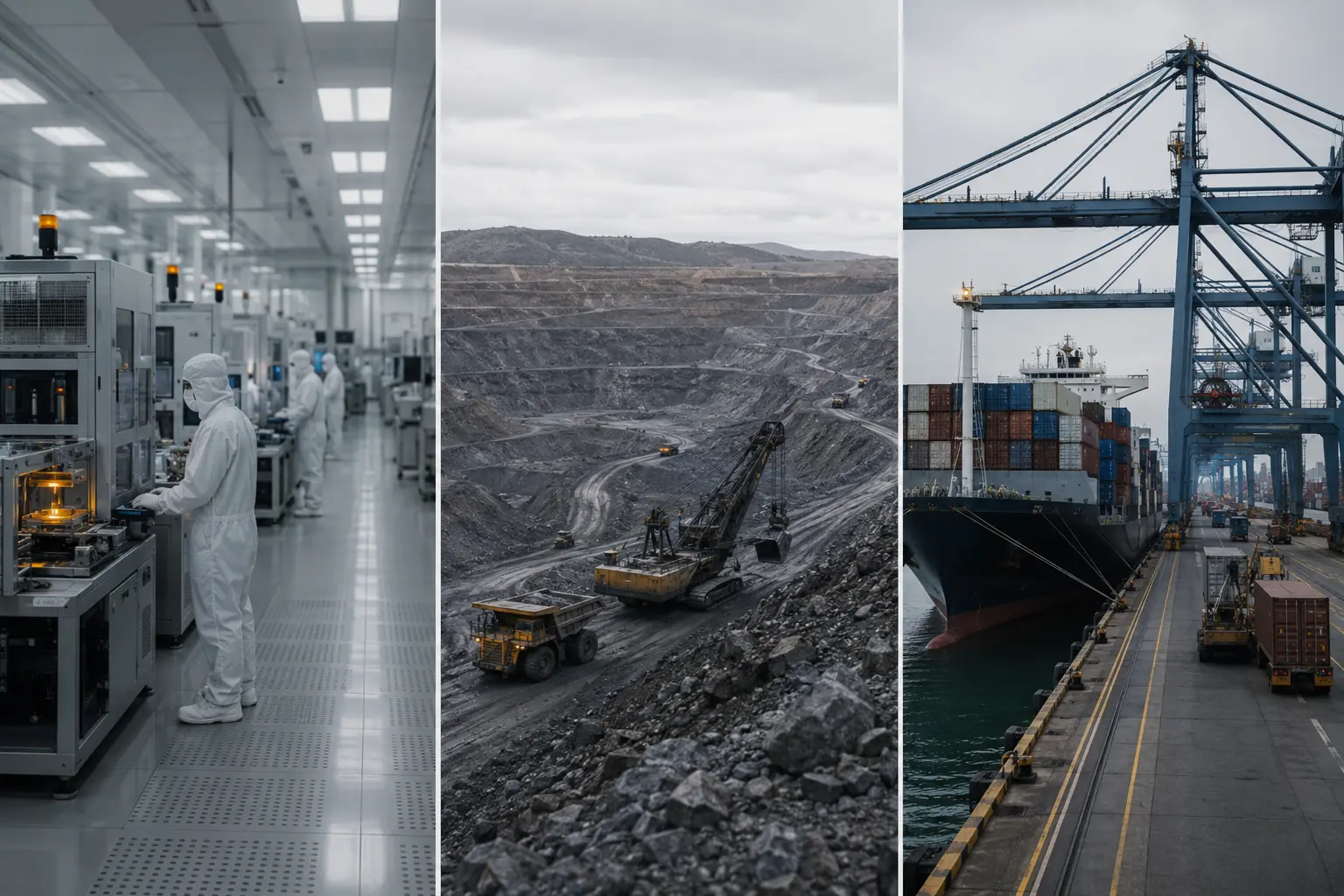
Every major AI system, whether built in California or Shenzhen, needs the same underlying inputs: advanced chips, data centres, and enormous amounts of computing power. The OECD’s analysis of AI infrastructure notes that chip design alone involves thousands of engineers and hundreds of millions of dollars before a single chip reaches production, and that hyperscale cloud providers are striking multi-billion dollar partnerships just to secure access to that capacity. Whichever country or company ends up leading the AI race, the businesses that design, manufacture, and supply the physical infrastructure underneath it are positioned to see demand either way. A habit some investors have picked up is checking a fund’s underlying holdings to see how much sits in equipment and infrastructure roles, rather than assuming a “tech fund” is exposed to one headline company alone.
The Rocks Everyone Needs
Long before anyone builds an EV battery or an AI data centre, someone has to dig up and refine the materials that go into it: lithium, cobalt, nickel, and rare earth elements. The IEA’s 2026 Global Critical Minerals Outlook reports that prices for these minerals rebounded through 2025 and into 2026 as supply tightened and a wave of new export restrictions from major suppliers reshaped the market. Both the US and China are actively racing to secure and process these materials, which tells you something important: this isn’t a case of one side needing the resource and the other supplying it. Both superpowers depend on the same finite set of inputs. Some investors treat this as a reason to look at materials and resource companies alongside the EV or tech names that get all the attention, since the raw material layer sits underneath the entire race, not on one side of it.
The Ships Keep Sailing Either Way
However the rivalry plays out, goods still have to physically move around the planet. UNCTAD’s January 2026 global trade update notes that nearly two thirds of global trade now flows through value chains being actively reshaped by geopolitical tension, tariffs, and shifting industrial policy, with companies diversifying suppliers and relocating production to manage that risk. That reshaping is itself a business opportunity: ports, shipping networks, and logistics infrastructure are exposed to the volume and complexity of global trade, not to which flag is winning the underlying contest. A common habit here is separating a company’s fortunes from a specific brand’s success story and instead asking whether it profits from trade activity broadly.
Common First Steps People Take After Noticing This Pattern
A free step many people take this week is pulling up the factsheet of one existing investment, whether a super fund option, an ETF, or a managed fund, and checking what percentage sits in infrastructure, equipment, or materials companies versus a single high-profile brand.
Some investors research the supply chain behind a trend they’re already interested in, looking specifically for the companies that supply equipment, materials, or logistics rather than the consumer-facing product.
A common approach is reading one credible report on critical minerals or global trade each quarter, rather than reacting to whichever headline is loudest that week.
Others use ASIC MoneySmart’s guidance on diversification to check how concentrated their portfolio already is in a single country or region, since a “US vs China” framing can obscure how much of a portfolio already leans one way.
Some people set a personal rule to review geopolitically driven portfolio changes only at scheduled check-ins rather than the day a headline breaks, since research on investor behaviour links reactive trading to weaker long-term outcomes. For anyone considering a bigger structural shift, such as changing how much of a self-managed super fund sits in international assets, that’s a genuine conversation for a licensed financial adviser rather than a habit to build alone.
Trying to predict who wins the US-China race is a bet most people lose. Looking at who profits from the race itself, regardless of the outcome, is a pattern you can actually act on. The real cost of skipping this isn’t missing a headline, it’s building a portfolio that only works if one very specific, very unpredictable story turns out exactly right.
If you want to build habits like this alongside others working through the same questions, MSH is a free community built around exactly that.
Join free here