Australia’s Economic Data Calendar: What Gets Released, When, and What It Signals

Australia’s Economic Data Calendar: What Gets Released, When, and What It Signals

Knowing when the numbers land is the difference between reacting to the news and reading it early.

Eight times a year the country stops at 2:30pm for the cash rate decision. But the Reserve Bank schedules those meetings around the data, not the other way round. The releases that shape the decision arrive weeks earlier, at 11:30am, from agencies that rarely make the evening news.

This article contains factual information about Australia’s economic data release calendar. It is not financial advice and does not recommend any particular investment, product, or course of action.

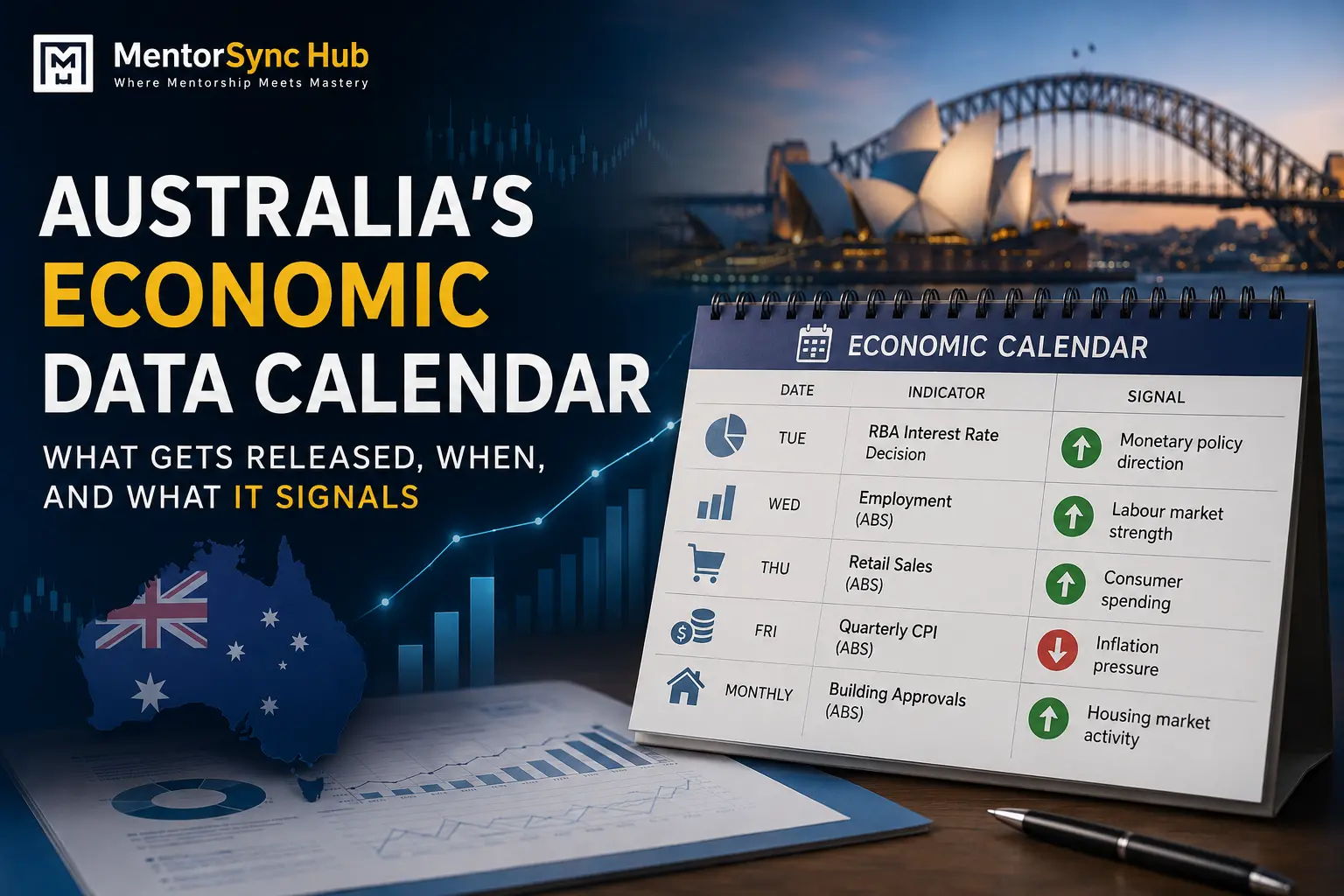
This is a working map of that calendar. Below you’ll find a week-by-week view of a typical month, then a directory of 20 releases you can filter by publisher or by how often they appear, and finally the habits people commonly build around them. Three things are worth knowing before you use it.

Three things worth knowing first

1. Inflation is now published monthly, not quarterly

If you think CPI comes out four times a year, that is out of date. Since 26 November 2025 the complete Monthly CPI has been Australia’s primary measure of headline inflation. The older monthly CPI Indicator has been discontinued, and the legacy quarterly series, including the trimmed mean, continues in parallel for at least 18 months. The two are not interchangeable. A monthly series also moves faster and is more volatile, so a single month is a data point rather than a trend.

The habit: checking whether a figure being quoted is the monthly headline or the quarterly trimmed mean before drawing anything from it.

2. The RBA publishes four things, and only one makes the news

The rate decision is the shortest document the Bank produces. Minutes follow two weeks later with the actual reasoning. The Statement on Monetary Policy lands four times a year with full forecasts. The Financial Stability Review comes twice a year and covers households, banks and super funds.

The habit: reading the minutes rather than the decision-day coverage, on the basis that the decision tells you what happened and the minutes tell you what was weighed up.

3. Two of the most watched numbers aren’t government data

The NAB Business Survey and the Westpac and Melbourne Institute Consumer Sentiment Index are privately published, released monthly around the second Tuesday, and both describe the month they appear in. Official statistics necessarily report on periods that have already closed. Sentiment is not measurement, but it arrives first.

The habit: treating the sentiment surveys as an early read and the ABS releases as the confirmation.

A typical month, week by week

Move through the weeks to see what tends to land when.

A typical month, week by week
Week one

The quietest week for headlines and the busiest for collection. The consumer sentiment survey is in the field during these days, sampling around 1,200 adults. Early-month indicators on lending, building approvals and household spending begin to appear. In February, May, August and November, this is also when a Board meeting and a full set of RBA forecasts often fall.

Week two

The privately published surveys land, usually around the second Tuesday. The NAB Business Survey reports business conditions and confidence for the month just gone. The Westpac and Melbourne Institute Consumer Sentiment Index publishes at 11am, drawing on the previous week’s fieldwork. Both arrive before the official statistics for the same period.

Week three

Labour market data typically arrives in the second half of the month at 11:30am Canberra time. This is the release that produces the unemployment rate. In months following a Board meeting, the monetary policy minutes are also published two weeks after the decision, which often falls in this window.

Week four

The inflation figure. Since November 2025 the Consumer Price Index has been published monthly rather than quarterly, generally in the closing week for the reference month roughly four weeks earlier. In the December, March, June and September editions, quarterly tables are published alongside the monthly numbers.

How often
No releases match that combination. Try widening one of the filters.

Australia’s primary measure of headline inflation since November 2025. Quarterly tables appear in the December, March, June and September editions. Background on the transition.

Employment, unemployment and participation. The source of the unemployment rate quoted everywhere else. Release page and upcoming dates.

Tracks how much households are spending and on what. Read alongside the sentiment surveys, it shows whether stated confidence is matching actual behaviour.

Measures changes in the price of labour, stripped of shifts in the composition of the workforce or hours worked. Split by private and public sector. Release page and upcoming dates.

The GDP release. Treasury officials receive it a day early under a formal lock-up arrangement, one of only a handful of releases treated that way.

Actual dollar earnings levels, as distinct from the Wage Price Index which measures rate of change. Useful for benchmarking, less useful for tracking wage pressure.

Two-day meeting, outcome announced at 2:30pm, Governor’s media conference at 3:30pm. Decided by majority of the nine-member Monetary Policy Board.

The reasoning behind the decision, including arguments the Board considered and rejected. Latest minutes.

A visual summary of the Australian and global economy in one document. Often the fastest way to see where a single number sits in its own history.

Released alongside the February, May, August and November decisions. Contains the RBA’s forecasts for inflation, growth and employment, plus in-depth chapters on selected topics. Current and past editions.

Assesses risks to the financial system, covering household and business resilience, banks, non-bank lenders and superannuation funds. Current edition.

Balance sheet data for banks, building societies and credit unions, including housing and business lending growth.

Industry-level performance, financial position and asset allocation, plus MySuper product-level data on returns, fees and costs. Published data and highlights.

Member demographics and total investments broken down for each APRA-regulated fund with more than six members. Fund-level data.

APRA assesses specified superannuation products against benchmarks and publishes the outcomes. Funds that fail are required to notify their members.

Tax settings, thresholds, transfer payments and the economic forecasts underpinning them. Superannuation contribution caps and tax rules can change here. Because those changes interact with individual circumstances, this is one point where speaking with a licensed financial adviser and a registered tax agent is genuinely warranted.

The half-year update to Budget forecasts and fiscal position. Lower profile than the Budget, but it is where revisions to the economic outlook first appear.

Business conditions and business confidence across industries. Privately published rather than official statistics, but widely cited by economists as an early read on activity.

Running since 1974. Around 1,200 respondents, five sub-indexes covering family finances, the economy and whether now is seen as a good time to buy. Also produces separate readings on unemployment expectations, house price expectations and mortgage rate expectations. Latest release.

A broader sample than the monthly survey, with more detail by industry and state. Slower, but a steadier read.

What people commonly do this week

A common first step is bookmarking two forward calendars rather than trying to remember dates. The RBA calendar lists meetings, publications and statistics in one place, and every ABS product page carries a “future releases” section showing the next scheduled dates. This takes a few minutes and costs nothing.

Many people pick one release and follow it for a full year rather than attempting to track everything. Following a single series through four quarters teaches you what a normal move looks like, which is what makes an abnormal move recognisable.

Some readers go to the source summary before the news coverage. ABS releases lift their embargo at 11:30am Canberra time and are published to all users simultaneously, with a short plain-language summary at the top of every release. Reading that first, then the commentary, is a habit that tends to separate the number from the interpretation of it.

Among people with a mortgage, a common approach is diarising the minutes rather than the decision. They land two weeks after each Board meeting and set out what the Board weighed up, which is a more useful input to a long-term view than the announcement itself.

People who follow superannuation closely tend to mark two dates specifically: the Federal Budget in May, where contribution caps and tax settings can change, and the quarterly APRA superannuation statistics, which publish performance, fees and asset allocation at industry and product level.

The accountability close

The rate decision everyone watches is the last step in a sequence that has been running publicly for weeks, and the releases that make up that sequence are all free, all scheduled in advance, and all available to you at the same moment they reach the professionals.

Not knowing the calendar does not make you worse off overnight. It just means the things that affect your mortgage, your wage and your super keep arriving as surprises when they never had to.

If you want to build these habits alongside others working through the same journey, Mentor Sync Hub is a free community built around exactly that.

Join free here
Everything you read here is written to inform and inspire, not to replace the guidance of a professional. Mentor Sync Hub is an education and accountability community, not a financial advisory service, and we don’t hold an Australian Financial Services Licence. For anything financial, please speak with a licensed financial adviser and a registered tax agent before acting on what you read. For health and fitness topics, always check with your doctor or a qualified health professional. For career and networking strategies, results will depend on your individual effort and circumstances. We’re here to help you take action, but the right action for you is something only you (and the right professionals) can determine.

Leave a Comment